
The long Way is short
- What drove me to madness
By Thomas Schmoll
01.02.2026 (draft)
Part 1
Kicking off
Take about a metre run-up, then whack it as hard as you can—the football. G. is in goal. And as he told me years later, even a scout from Stuttgarter Kickers noticed me, so eagerly did I kick the ball; but he brushed it off to them. Not that I, five years old, considered football the be-all and end-all back then, but I desperately needed the attention, and he gave it to me. However—the price was high. Really, in hindsight, the price was absolutely too high. But more on that later.
Well, that was the beginning of a, well, long story, which plays an intensely significant role in my life’s journey, though of course it all started much earlier. If I were to joke seriously, it would have been around four billion years ago, at the beginning. I’ll stick to serious jest and start vaguely in 1945.
There’s so much to tell about the people from that time, especially in our country—that’s obvious—and there’s even more to listen to from before that: from the expelled of East Prussia, from the tormented and dead of Jewish faith, homosexuals, the disabled and mentally ill, not to mention the Sinti and Roma. But the train seems to have left the station, at least in my family. My grandmother H. is still alive, but she probably won’t be able—or willing—to manage it anymore; unfortunately, she’s been understimulated for years and has hinted herself that she’s mentally declined. Who could blame her, born in the spring of 1931, her life spent and sacrificed.
That time between the First World War and before 1933 must have been quite pleasant, at least in East Prussia. It’s far away from Bavaria, where I was born, and over time, only dribs and drabs of stories trickle through: that older man I overtook on a walk, telling his companion how back then, in East Prussia, the world was in order. Or the reportage on „East Prussia’s ruined castles,“ which revealed that it had been a rich granary for the rest of the continent. And then my grandma’s accounts.
Well, and then? That absolute horror catastrophe, the Third Reich, raged, and I don’t write this gladly, but fortunately, then „the Russ“ came, as she tends to say. And now I’m not entirely sure, but yesterday, on the occasion of this year’s 81st anniversary of the liberation of prisoners from Nazi concentration camps, were Russian soldiers also liberators? Ah. Somehow, I had only stored the US Americans as liberators in my mind. That’s my bad. My apologies.
And unfortunately—well, generally speaking, of course unfortunately—then, fortunately, the Russians came. I repeat this, not just to pick up the red thread again, but also to let my statement melt on my tongue, so to speak, and to understand it myself. Because it’s confusing when I think about it. What can I say? Me, like millions of others who wouldn’t have been born. What are we supposed to say? Those who wouldn’t have been born, please raise your hand. But was it worth it? That’s not the point, that’s pretty redundant, okay. Note to self: You inherit old burdens. Fair enough.
Back to Grandmother H. and her siblings. They fled, of course, from near Königsberg, today’s Kaliningrad. And across half the continent, hundreds of kilometres over land. Until the Rostock area, at least—that’s where their children, my mother and her sisters, were born. What a drama that flight must have been. Pretending to be dead to sleep, lying in a ditch by the roadside. Featherbeds dragged on handcarts across the land; siblings, one of them barely school-age at the time, also being raised and fed along the way. What an absolute chaos that must have been! And I’m only focusing on my own family. It’s mad, isn’t it?
She hadn’t told me much. Unfortunately, I hadn’t asked much either. She’s a very sensitive and very intelligent woman, and in recent decades, she didn’t get much from me. But she must have sensed it, must have seen it—I was in a nearly bottomless slump. This phrasing is naturally misleading. Knowing her, she means I didn’t pull myself together enough. I can’t blame her for that. But it’s still hard to bear, of course.
Anyway, she paid with her spirit, kind of like in the story of Timm Thaler and the Sold Laughter. She’s become quite harsh, apparently—not bitter, just hard, at least on the outside; but lately, I got the impression that she’s made peace with the world. And what’s also interesting is, if you ask her, “How do you talk to me, then?” or something like that… well, there’s a radical switch in her tone.
But there are a few questions that occupy me: Was she raped? How were her parents killed? No idea. Was she beaten? Well, she did tell me that much.
She and her family were tormented by the relatives they stayed with, as she recounted. But things took a turn for the better. Early enough, she recognised the signs of political change in East Germany and fled again with her now-husband, put two or three layers of clothes on her children, and moved on to Lower Bavaria, where they built a house.
I know little about this journey, too. It does surprise me that all her sisters ended up in Osterhofen, in the Deggendorf district; her brother found his luck in Stuttgart. I’ll come back to this branch of the family later; there’s not much to report, also due to lack of contact and knowledge. However, what I do know is quite something.
That I haven’t mentioned my grandfather Heinz earlier, and only now bring him up almost incidentally, is due to the temperament he expressed in his lifetime: calm, amusing, hardworking, modest. Throughout his working life at one of Bavaria’s car manufacturers, he got up very early every day, baker-style, so to speak, took the bus to the factory, came home early, went to bed early; in between, he tended to the house and garden and led a solid life. Sounds simple enough in my mind’s ear, “solid life”… but, to be honest, I barely knew him.
“There’s a big river flowing, and on one side stands a little monkey. So, how does the monkey get to the other side? … You don’t know? Well, if you, the big monkey, don’t know, how is the little monkey supposed to know?” – his favourite joke.
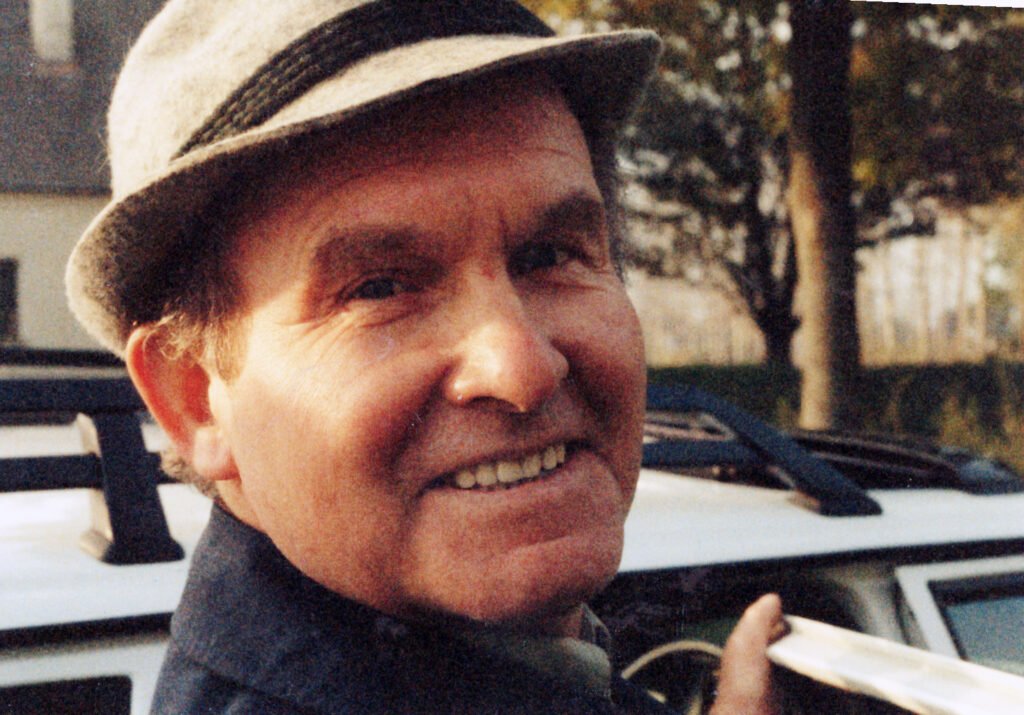
Heinz P., circa mid-1980s.
In the swimming pool, G. once told me, he had approached my mother. Quite interesting, actually, at least as I see it now. There’s little to hide there, after all. Note to self: You’re overinterpreting. But opportunity makes thieves. Fair enough. And in his defence: You’ve got to celebrate as they come. Anyway, from then on, until my mother Rosemarie Gisela’s death in January 1995, he seemed to be part of her life, and until last year, part of mine too. Some things just sneak into everyday life, and you don’t notice. At least not as long as you’re not “living consciously.” Curious and strange, occasionally.
Doctor Manfred K. said that once during treatment in his practice in Balingen. It was the answer to my question: what can you do about it? He noted that my life energy was almost depleted. I was about twenty years old, still young, but by no means surprised. Curious, though, and I wanted to know more. What exactly, you might ask? Well, living consciously. Ha ha. I’d completely forgotten to mention that. I didn’t press further in the conversation but unconsciously decided to figure it out for myself, in my life. Live consciously. Try that. Sounds simple, but in the 90s, you didn’t hear that every day. It’s not as easy as breathing consciously, more like bleeding consciously—somehow intangible, quite abstract, or not?
It’s naturally difficult to write a book about a—my—life and resist the urge to read out various indictments, especially when it comes to people suffering from psychiatric disorders. But perhaps you’ll understand when I write here that it left a bitter aftertaste when, after forty-five years, I realised and understood exactly who I’d been wrestling with almost incessantly over that period: a psychopathic narcissist.
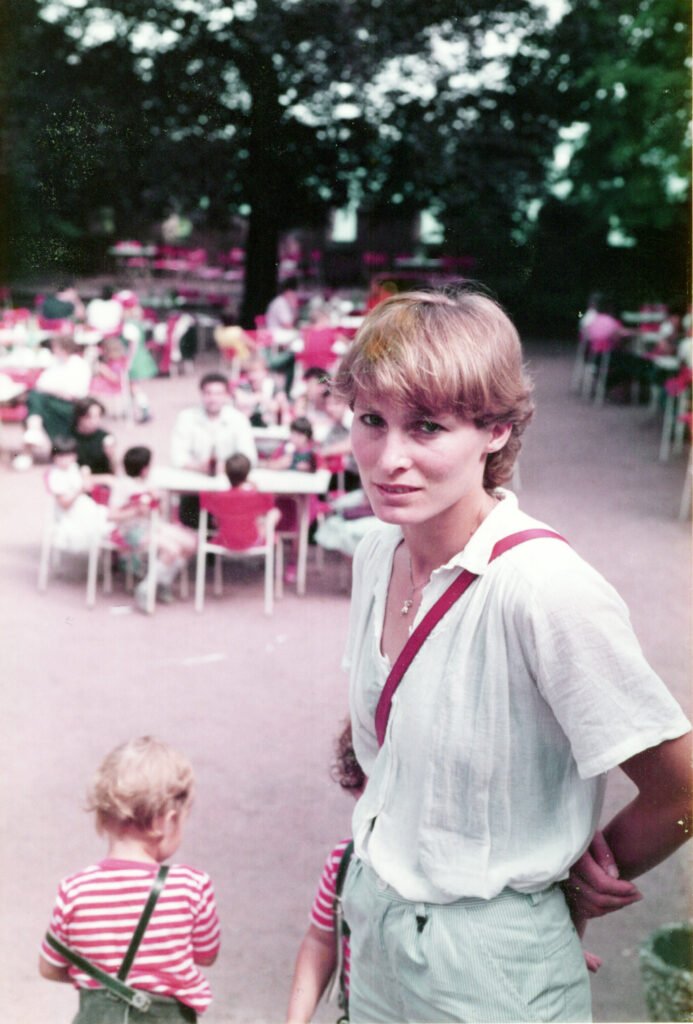
My mother may have unconsciously suspected it—at least that’s how I interpret her facial expression in one of the photographs G. took of her in Stuttgart during their first years together.
Rosemarie Gisela, circa 1985.
I had a hunch something was wrong, but I still somehow ended up under the wheels. In recent years, partly due to one or two songs about this mental state, a new social awareness has emerged. Not least because of Donald Trump, narcissism has somehow become socially acceptable; though Mr. Trump is certainly not the first of his kind—he’s probably one of that kind—and yet, in such a globalised world and in a comparable role. Frankly, I found it odd that he had an appearance in Sex and the City. But how did I eventually conclude that G. was committing psychological abuse, making the term “psychopathic” entirely justified? Hmm, I can’t say exactly, because it’s like putting together a huge jigsaw puzzle for decades without knowing what the picture looks like. You suspect, and suspect, and wonder, and flee, and distance yourself, and yet still crave attention and seek recognition. It’s a huge pile of… well, you know.
All I can truly grasp and describe in a way that makes spontaneous sense when you read these lines is this: A few months ago, sitting at my desk in my Munich flat, lost in thought, ploughing through my life in my mind, pondering G. and our relationship, I simply realised that he is what people commonly understand as a psychopath. And upon this mental breakthrough, my whole body tingled for three minutes. I’d never experienced that before. And the relief since then has been truly phenomenal.
Ah, intuition—a vast field, and probably often underestimated, at least emotional intuition, in my opinion. Most people will rely on their feelings. It’s normal; that’s how you grow up, usually. The few hundred thousand people here who haven’t learned that and therefore (yet) don’t do it—and perhaps even more so those who, as a result, find themselves in an anxiety disorder—can probably find strong words for how or why one should consciously integrate intuitions into one’s life.
It’s not about dissecting everything in a metaphorical sense. Not at all. But reflecting—and actually, Manfred Kuhnle, wherever you are right now—live consciously.
Yes, it was he, Manfred Kuhnle, who once told me, “Colorectal cancer—it’s assumed to be psychologically induced.” That was, of course, a helpful tip. No irony. Not at all. It’s naturally very difficult to judge this in hindsight, and even more so regarding a life that’s essentially foreign to me. Post-war children who had to endure or even instigate one or more hasty moves—perhaps out of an inner necessity inherited from ancestors—and who lived life to the fullest, given the times, must have had to look around, I suppose. At home, we didn’t talk much about such stories or events, like her abortion or stillbirth, intuitions about the character traits of in-laws—not… well, not… probably… a shame, of course, but wasn’t or isn’t that the plan?
Plan? Whose plan? G.’s plan? God’s plan? The devil’s plan? Or just fate? Or perhaps part of evolutionary behaviour not yet on its to-do list?
It remains an open secret. The deceased take these things to their graves, and resourceful descendants dig around in them—if only intellectually. Of course. But this statement, “Colorectal cancer? Probably psychologically induced,” got me thinking for a long time, until I felt the stream of thoughts ended in a dry riverbed. This leads me to another topic, but more on that later.
Actually, it was my father Harald who told me about the abortion. The mental leap to the abortion comes from a decades-long recurring thought: that my mother probably had an abortion performed on herself and possibly died as a result—among other things, of course.
Harald, in any case, had a good heart. This is evident, among other things, in that he told me he had driven my mother to Vienna for an abortion—this was in the mid-to-late 1970s—but he omitted that the foetus was likely the result of what was called a “sexual misstep.” Misstep? Stupid word. She just allegedly cheated. My youngest half-sister, L.-M. N., told me this once during a chat.
Live life to the fullest—and make the most of the time. Go for it, ha ha coughs.
But the following: Please don’t misunderstand. It was her life. It was her body. And women have the absolute right to decide about it. Of course—but apparently not for everyone.
Well, I’m not entirely sure, but in that regard, I seem to have inherited something from her. Now, one could say, ah, what a nice excuse, almost euphemistic… but in truth, it’s correct that the final decision was mine. And this often went against the relationship in which the “object of my desire” was currently involved, or this played a subordinate role in my decision-making process: “Sex? Yes or no?” I gladly submitted. To whom? Fate? My sex drive? Yes, exactly. You know what I mean? Please don’t judge me, ha ha, we can’t help it. And what do I mean by “we”? It’s currently quite undefined. But honestly, it seems more important to me to pass on my genes than to emphasise righteousness on our banner. This also fits with my ancestors, whom I believe set out from wide China or Japan towards the West, and among whom there were also pirates.
Personally, I don’t consider myself righteous, at least not compared to how G. presented himself to me. Correct in a social context, yes, but what I know about righteousness—even if this term was overused and abused by this adoptive family—no. Hmm, I’ll go down this path and ask Copilot:
Oh, no, thank you. It’s too much for me. The term causes me significant discomfort.
But let’s briefly expand on this: “Please connect righteousness with narrow-mindedness.”
No, thank you, you might almost say, but it was enlightening all the same. Over time, concepts in my thinking and perception have blended. Very interesting, though.
Back to the cheating, and I say this with one laughing eye and one crying eye, and after drying the tear: It’s good that I was able to recognise this even after all this time. A sparkling commonality, if it turns out to be true.
She’s been dead for three decades plus one year now. I spent that weekend in early January 1995 mostly on four wheels and on the road; I visited an old school friend in the Allgäu, F. To G.’s reluctance, and no doubt to her sorrow as well, because I’m convinced—still am, to this day—that she had a hunch that her health was deteriorating. More than that, that her life at that time might already be perceptibly hanging by a silken thread. Whether she had her death directly before her eyes and saw it coming, I naturally can’t say—how could I?—but in my mind’s eye, I can still see myself leaning against the kitchen counter in Owingen, in the rented house on Neue Straße, and her sitting in a comfortable camping chair, directly opposite in the room… and us looking into each other’s eyes, silent—knowing, or perhaps just intuiting once again that we probably wouldn’t see each other again. Difficult, of course, to interpret such situations—yes, I know.
Right after her death, I began to anchor this moment in me as a silent farewell. And truly, this moment had comforted me all those years, those decades, time and again. Even if, because of that silence between us, it was very regrettable.
When I see her in pictures now, looking weak and exhausted, struggling to maintain her posture, it naturally makes me want to cry. Not necessarily because she’s my mother, but because a suffering person’s hope is dying. But I won’t deny the deep pain inside me; no one was closer to me in my life. It’s a tragedy (it was). But how have I kept her in my memory, even after all the acts of sabotage by G., who really made her do all the dirty work in raising me? Aaah. Yes, this rising anger pulls me out of the muck.
Back to the question: For a long time, I had her master’s thesis hanging on the wall. See for yourself:
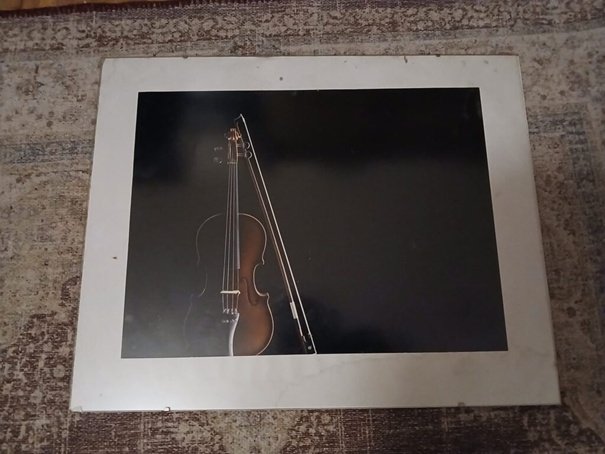
Probably created in the late 1980s or early 1990s.
I’ll take care of this picture again; it’s been standing aside in the clutter for a while. It deserves a nice frame and a nice place, doesn’t it? Great, right? Imagine the music of Johann Sebastian Bach’s Air to go with it, or just listen:

Johann Sebastian Bach: Orchestral Suite No. 3 in D Major, BWV 1068: II. Air (Karl Richter)
https://link.deezer.com/s/32hlJEZ3HSGwIGcMuv3wH
Sounds beautiful, doesn’t it?
Ready
The memory of time in Stuttgart-Degerloch is naturally a bit vague in my recollection now—it’s been about forty-five years, after all. But sometimes, even these memories from that time feel very close to me, at least when I have them before my mind’s eye or ear. They mostly consist of images, comparable to still frames from videos, and sounds or snippets of audio, like individual, usually short sentences. Though I don’t hear these directly. It’s different in situations when I believe—or assume—that I’m hearing God or the Devil. I’ve even felt like I had a conversation—with God. Alright, alright, I know—or at least I can imagine—how this must read: a mix of craziness and delusions of grandeur. Along the lines of, ha, God speaks to me.
In truth, I believe God speaks to all of us; we just don’t hear it, or rather, we misinterpret it. This isn’t knowledge, of course, but rather a theory or a deeply rooted belief. But that inner voice in us, that good or often bad feeling in the pit of our stomach, could very well be interpreted as communication with or through God. But I won’t commit to that. Everyone—and everyone in between—should figure that out for themselves. Obviously.
By the way, thank you for continuing to read. Some might put the book down now. Well, the question is, from which corner you’re coming from, or rather, which theories you subscribe to, isn’t it? A few family members—on my mother’s side, even both aunts, T. and B., their children M., M., and E., and also a great-uncle H. and his wife D., along with their children Heinz, H., and K. (whom I’d mentioned earlier)—are Jehovah’s Witnesses, for example. That’s “one corner,” so to speak. My mother was also very close to them but, due to the fact that she occasionally smoked, wasn’t fully accepted. Instead, she was probably only tolerated at meetings, quasi as a candidate or, more realistically, for influence. That’s how I experienced this washed-out bunch up close in my childhood, which means I occasionally attended so-called meetings (that’s what they call their gatherings for practising and living out their faith) and was familiar with the organisation’s—or rather, sect’s—children’s books. It’s a peculiar lot, that much is certain, and it’s good that the path didn’t continue further back then. Not every soul, not every body, can endure that influence in the long run and remain healthy. I’m talking about Heinz K. Jr. He jumped to his death, allegedly—that is, according to my family’s stories—from the TV tower in Stuttgart. A catastrophe. I won’t write any more about it. It’s too opaque. His life and that of his parents and siblings had little to do with our world, and further speculation might bring about misfortune. But let’s continue, though in the same context:
In fact, I still notice their influence—the Jehovah’s Witnesses’, that is—decades later. For example, during my confrontation with the topic of organ donation. Jehovah’s Witnesses strictly reject it—that was also the reason for my mother’s more or less sudden death: she didn’t want a foreign liver in her body. And indeed, I had to go through a longer process when deciding on my willingness to donate organs, as I initially didn’t want to donate, carrying a conflict within me. It’s quickly told: a conflict in the sense that, while I knew it had to be done, I still inexplicably decided against organ donation readiness on my first ID card, which I then carried with me. Well, that was something, as you can probably imagine.
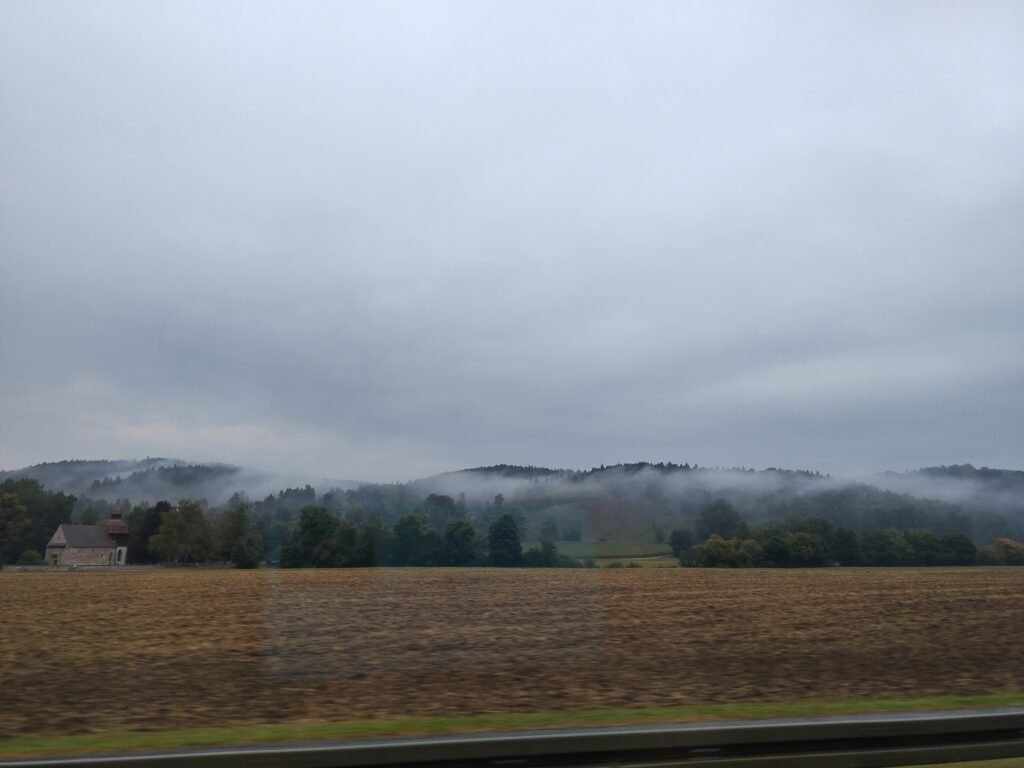
View of the cemetery with chapel in Haigerloch-Owingen in the Eyach Valley, Württemberg, Zollernalb district.
I still remember the weather at her funeral well: it was sunny at first, then within half an hour, the clouds gathered, and all of us ended up in a kind of snowstorm on the cemetery. Strange, that was. I don’t want to read too much into that weather front at that moment—when you lose the ground beneath your feet, you tend to do that; at least I do, as far as I can remember. All possible eventualities are just ticked off. Somehow. Like, coincidence, maybe, and if not, then what could it be? I didn’t consciously ask myself such questions back then. I was basically rowing alone across the open, stormy sea. At the open grave, when it was my turn to supposedly and apparently say goodbye under everyone’s gaze and throw dirt and a bouquet of lilies onto the closed coffin, I didn’t think about the people in the background. My heart was broken, and I crouched down and stayed there for minutes. E. D., my ex-art teacher, who had become a friend of the family by then, rescued me from my crouching and increasingly snowed-in state and led me away from the grave. That’s all I remember from that funeral. Where the rest of the family was, no idea—then or now; it didn’t matter.
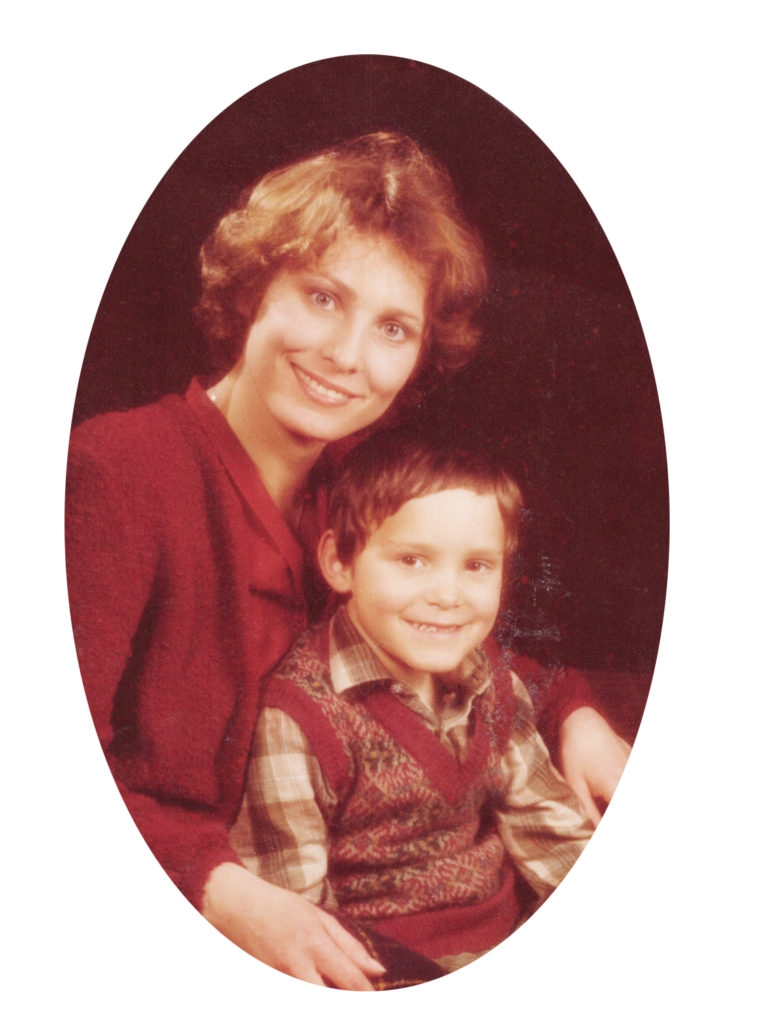
Circa 1981.
It was the first time I’d seen a corpse, by the way. The woman, an employee at the Balingen district hospital, led us up the stairs and opened a door to a dark room. Us—G., who had driven us there, my two half-brothers, and me. And there she lay—back then, her; today, her body—now… in artificial light, still and freed from all pain and worry, dead. Like being clamped between two baseball bats, it hit me from the front and back in my imagination, slamming into my skull and putting me in shock. My brothers burst into loud, wailing tears and fled from the room, around the corner. I just functioned, following them, taking them in my arms, and there we stood. Blackout.
A week later, I started my apprenticeship as a draftsman for the third time—or rather, continued it, more poorly than well—and somehow struggled through. But I would finish it, that much I can say in advance. About half a year later, I moved out after G. suggested it in a typed letter. I couldn’t even think about things like moving out or living my own life—not just back then, but seriously, until last year. I’m not entirely sure, but ever since my near-death experiences in my early and late childhood, I’ve somehow just let myself drift. At least that’s how it felt. Today, I call it emotional confidence, or emotional certainty. I had no doubts until I moved out of my parents’ house. I wrote a farewell letter to A. and P. S., but I didn’t give it to them. I had a friend read it, and after moving into the room of the shared flat in Balingen, when the ties to my deceased mother and spatially distant adoptive father threatened to break, doubts and extreme anxiety attacks hit me like a bomb. Marijuana and Kitaro, as well as meditation to his music, helped me forget my pain and my body, but it was naturally foreseeable—at least with today’s research and knowledge—that this wouldn’t last long.
To the outside world—or at least that’s what I was occasionally told when I asked—I apparently conveyed an air of indifference or serenity, but inside, there was pure despair. Sitting for hours, paralysed, in a red, ornate, noble but worn-out armchair I’d saved from the bulky waste was not uncommon. Nor was searching for a rope in the attic next to the terrace of that building, right on Bundesstraße 27 in Balingen—though it probably served more as a distraction and a way to lick my open emotional wounds. I only pretended to have suicidal intentions. Deep down, I knew that—even if it meant I didn’t know what I was doing. But I didn’t want to make a second cry for help disguised as a suicide attempt; I already knew that hopelessness and meaninglessness—plus, it was naturally too risky to actually have to die. All that existed was self-pity. Or, as the first psychotherapist in my life, C. K., simply and poignantly put it: self-with-suffering.
How I ended up with her, I can’t say anymore. It’s just chaotic and not stored chronologically, naturally due to the psychological overload that would soon develop into a schizoaffective disorder.
It might sound far-fetched to some, but this disorder was actually my salvation. With my current experience, I can say with certainty that a solidification of anxiety into a generalised anxiety disorder would probably have been my downfall. In fact, I did have such a so-called generalised anxiety disorder later in my life. But when I think about how psychiatrists treated me twenty years after my first overwhelming anxiety attack (with a few exceptions), and how late brain research and insights into it were developed—and thus the Bernhardt Method—it makes me grind my teeth.
I’m serious: I’d rather have slid into one of the most severe mental disorders of all—through anxiety, grief, drugs, and the associated overload—than live with a generalised anxiety disorder in the psychiatric industry of that time. Seven or eight years ago, the cards were reshuffled thanks to some clever researchers, but it’s unimaginable how it would have gone for me, living a life as a young, medically inexperienced man, submitting to doctors. A horrifying thought.
It’s probably not easy for outsiders to understand why I’m writing this. But it becomes clearer when you critically engage with the medical and pharmaceutical industry—and also self-critically reflect on and adjust your own behaviour towards doctors. The background is the medication used to treat mental disorders like generalised anxiety disorders and panic attacks, and unfortunately, they’re still used far too often. The sufferers are usually at the point where they’ll grab at any straw.
We’re talking about benzodiazepines—a pretty disastrous substance that quickly numbs and thus provides relief, or at least the illusion of it, but after just ten, fourteen days, it already creates dependency. Moreover, it can—or does—change the personality, at least with long-term use and the associated addiction. In my case, it did. Compared to that, there are antipsychotics, which are used to treat schizoaffective disorders. Schizoaffective disorders consist of schizophrenia—in my case, mixed with paranoia—and an affective disorder, basically a bipolar disorder, previously called manic depression. However, it should be noted that, as this manifests in my illness-related disorder episodes, I drift into mania without sufficient medication and race through life at full speed. Then, due to the schizophrenia, I additionally succumb to madness… which, due to the conscious experience and later memory, can be quite entertaining. What’s spectacular, though, is my sensitivity during the transitions from one phase to another.
But usually, a depression followed—though, based on experience, only if I was overprescribed antipsychotics, possibly for reasons of saving time or because that’s just how it’s taught and maintained within mainstream medicine. This then leads to a crash in my ability to feel, and the resulting depression usually lasted three or four months, during which I mostly fought my way through life and society alone or with psychotherapeutic and outpatient psychiatric support. It was exhausting. No one needs that. But just to let that sink in, this is inpatient treatment with medications that immediately lead to another, fundamentally more dangerous illness.
But I want to mention one peculiarity of this illness, this mental reaction: during these brief phases of transformation between the so-called healthy state and the pathological episode, I could act significantly more free of anxiety and much more honestly towards my surroundings. And that was an incredibly important experience for me. Especially since this family and the relationship with my adoptive father had plunged me into the deepest confusion.
Now, at this point, one might take the time—ironically—and ask: how are you supposed to figure all this out and live a life at the same time? Imagine having children or children already being in the world? Who can manage that? And who dares to truly plough through life like this? More people than you’d think. But it alienates. And it leaves a lot of scorched earth. And, if you can afford it, most relationships fall by the wayside. Understandable. We learn to suppress emotions in public. It’s no secret that this concept of personal development often runs counter to that. I’m described as “emotionally unstable,” or even threatened with statements like, “If you scream, you’ll be restrained.” Do you believe me? Can you imagine that? Or have you heard the story of patient J. J. from Munich, who was restrained in a clinic and sexually abused by a fellow patient during that time? Yes, that’s the industry: tested, cared for, reliable. And organised by academics. Mostly, anyway. Please excuse the outbreak of budding sarcasm; it’s currently 5 a.m., and I’ve got the day ahead of me. And budding sarcasm is easier to digest than erupting rage, in the form of smashing a metal bin. As mentioned before, that’s what they’re there for—that’s why they’re called that. Though, of course, lived-out anger isn’t trash. The question is, what about aggression?… Wasn’t that also a side effect of testosterone?
But let’s be honest: how am I supposed to react when an on-call doctor “treats” me after only questioning the nursing staff, then unnecessarily prescribes two sedatives against my explicit will, and orders a nine-hour restraint? Worse still, the public prosecutor in Lower Bavaria who took the case then said it was appropriate under the circumstances.
Okay. 10, 9, 8, 7, 6, 5, 4, 3, 2, 1, 0.
Part 2
Strange Women
The first time I realised—albeit very unconsciously, of course—that women were different was when, at three or four years old, I saw my sandbox friend naked. It left an impression I can still picture to this day. Then, for a long time, there was silence—if I exclude this loudmouthed girl from kindergarten, S. K., who was the first to leave an impression on me regarding strange women or girls. She was the one I’d go to school with in second, third, and the following grades, until repeating the ninth grade led us down separate paths. On the first day of school, at the bus stop in Haigerloch-Owingen, she tapped on the rear window of the Passat where I was sitting, not happy at all. She told her school friends in that thousand-soul village, early in the morning, “Yes, that’s the new one.” Later, her unusual, equally loudmouthed manner would regularly inspire me to embellished fantasy trips. But somehow, she was a bit bizarre, yet she early on endeared my heart to outsiders and their male counterparts.
Then there was B. S., also loudmouthed and equally coarse as S. “Pants down, legs apart, fucking’s no big deal,” I once shouted after her when I was eight or nine. She reported this hot off the press to her father, who then complained to my adoptive father. This little incident—a path of information—would repeat itself as another minor matter about ten years later. So, country life. What can I say? Blessing and curse.
Then, yes, then came S. H. in secondary school into my life. Not really, of course, but she had captivated me. I only let her know nonverbally, like when I once chased after her at the ski lift in the Alps during a school trip to secure the seat next to her on the way up the mountain in the south of the nation. A few months ago, when I was in Haigerloch and the surrounding area for several weeks and coincidentally ran into her, I let her know that, too. Funny, because it was both flattering and a reprimand, as her reaction—fleeing from me in the queue—meant a sudden and humiliating end to my openly displayed desire. Back then, it was short and humiliating, but final.
That made room, because life, of course, went on, as did school. Actually, the saying should be expanded: School, taxes, and death.
Her name was A. S., and it was more intimate. We got along wonderfully and even had a few private moments. Flatteringly, she wore one of my shirts in public for a day. But in another moment, in her room, at twelve or thirteen years old, as intoxicated as I was by her, by that crazy feeling, I couldn’t take the next step.
Now it occurs to me—I really don’t know when or which girl I kissed first. Strange, that.
After A. and the insurmountable hurdle—which wasn’t my last, but the first conscious one—I turned my attention to the district town of Balingen and the girls there. That is, I courted K. I met her in the disco at the Schwenzer dance school, and things developed further, this superficial love play. We danced closely on Saturday evenings to Pierre Cosso’s “Dreams” and the like, in a cloud of the trendy scent “Musk,” and made out on the following days, eventually in my room. There, following a certain automatism, I went a step too far. It seemed okay, apparently, even if she didn’t want to go further—it was just too much. Typical boy, I’d say now. This principle, too, would repeat itself. K. and I were more active than in all my previous relationships. But after a day together in Stuttgart, where we took the train, I had to pull the emergency brake: on the return trip, I couldn’t handle so much closeness anymore and rode back in the adjacent compartment, separated by a sliding door. Anyone with a bit of heart can probably imagine that this was a catastrophe and, of course, the—unfortunately—unspoken end of that friendship. But I couldn’t do it anymore. It was an abyss, and I fell right into it.
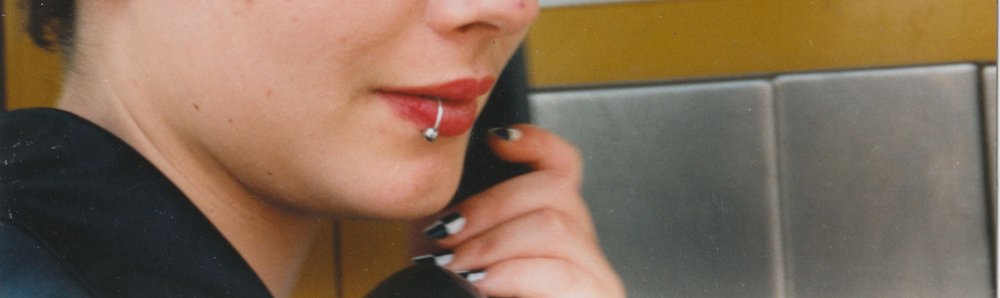
E. M., circa 1994.
What followed then increasingly turned into a tragedy: I got to know alcohol. No half-measures. Beer wasn’t really in vogue in the clique I was part of. We mostly drank wine, and for me, it was usually half a bottle in one go. Not out of addiction pressure, though I was psychologically more than just hooked—no, of course, it was also showing off, similar to smoking. Obviously.
What came next, everyone can imagine: making out with girls as a drunk teenager. The next morning, I found myself standing in front of a door where the second D. in my life lived, but I hadn’t the faintest idea what she looked like or what to expect.
And so it continued. I can’t list all the girls or young women now—sometimes it didn’t go beyond a visit to their place, or maybe several visits (though occasionally just platonic)—but a clear and repeatedly occurring scene was already emerging: frequent changing affairs, alcohol, and a problem with closeness.
What can you do? It’s already pretty dramatic: forgetting the first kiss, and the first time having sex with a woman on a campsite at Lake Constance on an island, with S. S., in a tent, where she kept the other campers awake—exaggeratedly staged and artificially moaning, probably also amusing them—and my half-brother, the younger of the two, P. S., sleeping next to us, waking up from the noise and asking, confused, “What are you doing?” No need to answer that question, right? Or is there?
I’m wrestling a bit with my beloved gentle feelings now, but my insides twist when I dive into that time—even just in my thoughts. Because, of course, another emotional catastrophe was looming on the horizon, and I was heading straight for it. Weeks later, back home near the cliffs of the Swabian Alb, I had to learn over the phone that S. had a boyfriend, had cheated on me, and had also fled from me. “She’s afraid of you,” her mother let me know in that indirectly clarifying conversation. Well, what can you do? Confidence looks different. But I visited her now and then. The first time having sex with a woman—what was I supposed to do? Ha ha.
Coping Difficulties
Most likely consciously ignoring natural boundaries, he marched into my room. The first time we were together in that space, my third childhood bedroom in that house. He entered without knocking, hence my assumption of this premeditated, calculating attitude towards me. I sat there, depressed, staring at a candle, humiliated and insecure, into his genuinely satisfied, sparkling dark brown eyes. We talked about something—I don’t remember what—and then he left me alone again. I must have been nineteen. I assume so, based on my mood. Music had always been what kept me alive, and pornography—so to speak. I’d had sex before, but as you’ve already read, relationships had always been a burden to me. The first time had been stress-free, but that didn’t change the fact that relationships weighed me down.
What had obviously accompanied me since childhood was an adjustment disorder. One symptom was nocturnal bedwetting between the ages of five and twelve. The depressive mood I mentioned earlier, caused by the illnesses of my half-siblings and my mother, also pointed to this. Additionally, I categorically rejected change at first, which led me to decline events like family outings. I was then overlooked, and somehow I could go along with it, even enjoying the moments in phases. But by the end of the day, I was exhausted. This manifested in an excessive need for sleep and, as it turned out much later, extremely low blood pressure the next morning. My mother, that stupid cow, actually woke me up repeatedly by throwing a cup of cold water in my face because of this. Which eventually led to violent aggression from me towards her. Aaah, brutal. Damn it. A tragedy, really. But we simply didn’t know any better—what could we do?
The bedwetting was, of course, a problem. Not always, not everywhere, but usually. Everything was tried: tone-emitting, electric pads, diapers, even psychotherapy. Christ. I can’t imagine what would have happened if this had become known at school. But in seventh grade, during a school trip under the supervision of our class teacher, Mr. Mayer, I apparently felt safe, and everything went smoothly. Even if there were other difficulties, like a crying fit and a really hard slap in the face from my mother when my family visited me there. I’d pretended on the phone that they could visit me, but deep down, I didn’t want to see them. So when they did visit—after driving 120 kilometres through Württemberg—I reflected my bad mood in my facial expression. That was a huge problem, of course—emotionally and socially, in every sense, very costly.
I wasn’t beaten often. There were four instances where my mother did it, and four where G. did. With G., things sometimes got wild. But no matter how wild, he didn’t emotionally hurt me. It left me cold, somehow. With my mother, it was different. She was always very emotional, and the last time, she was pretty desperate. Looking at her mother and that entire generation, it’s no wonder, especially if the son had Southeast European temperament in his blood. But that somehow got lost through the adoption by G. and only later drifted back into my consciousness. Although I don’t think I ever met my supposedly Croatian-born grandfather. My father’s father was named Jadanić, and my grandmother was Emma Krieber, Austrian by nationality, living near Villach in the state of Carinthia. I met her briefly, unfortunately at a time when I found nothing interesting about seniors. A real shame. Unfortunately, all previous attempts to contact this part of my family later, in the age of social media, have failed. But that’s probably due to the complicated delivery methods of messages on these platforms—like on the first major one, where you have to be friends to send a message. So, if anyone knows these people I’ve mentioned, please let me know. I do bite occasionally, but only under very extraordinary circumstances and if someone vehemently inflicts physical harm on me; I fight like a dog—I’ve observed them for a long time. The laughter sticks in my throat now—does that surprise you after this chapter? But it’s over. That’s a comfort, even if it’s tinged with a slight bittersweet melancholy.
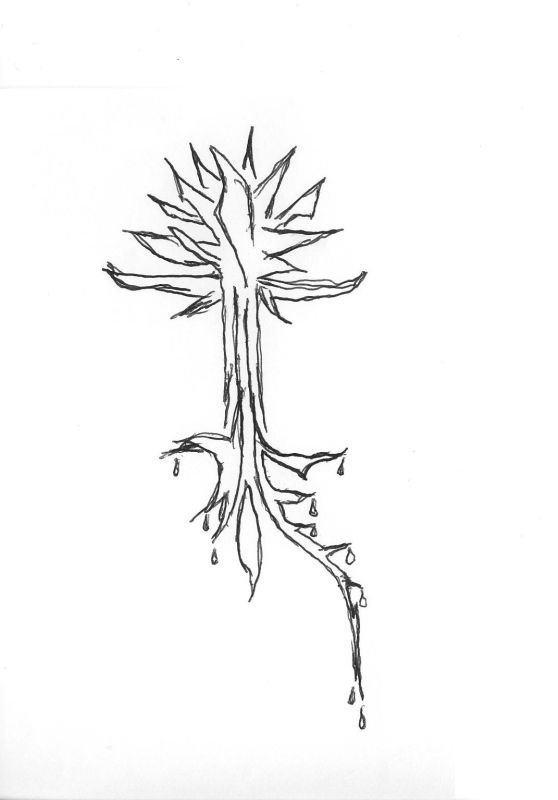
Later, circa 2004.
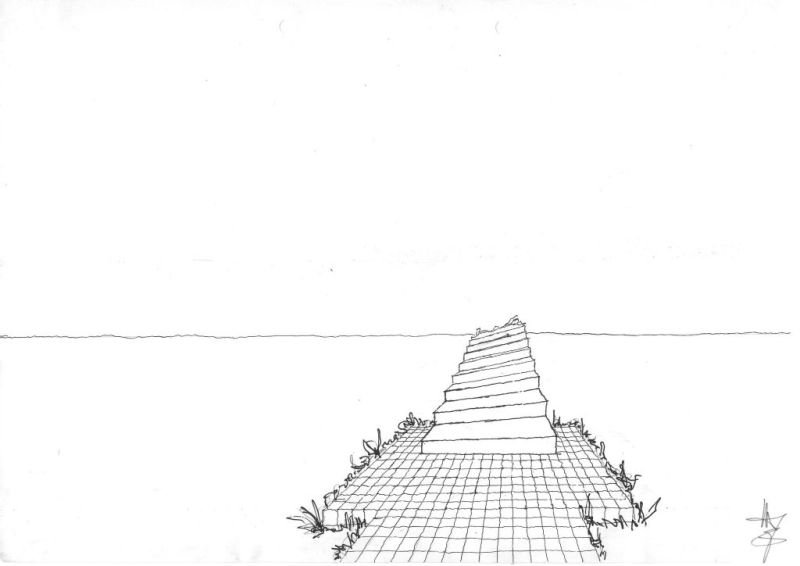
Earlier, circa 1996. My way of processing my mother’s death through a drawing, accompanied by Led Zeppelin’s „Stairway to Heaven.“
Psychiatry
The differences are indeed astonishing. Swabia/Württemberg, Swabia/Bavaria, Upper Bavaria, Lower Bavaria, Paris—these are roughly the most notable and, over the decades, the most formative experiences, simply: stays in these—mostly—district hospitals. First time in 1995, last time in 2025. And of course, money plays the biggest role, depending on the perspective you take, or—now I’m really struggling to find the right words—who you’re addressing. I mean, the staff. You never see the head physician, the senior physician once or twice a week—depending on how you treat the furniture and nursing staff. You see the assistant and ward doctors often, and the nursing staff daily. So far, it’s the same as in the physically oriented clinics of conventional medicine. Now, shall we go further? Who bears the responsibility on a ward? Actually unclear, when I think about it, but probably the ward doctor? Or the senior physician? Or how? The head physician? Or the ward manager? Hmm. Strange.
Next: Who is trained how? And who has experience with what or whom?
Oh, I won’t find answers here. I can only dig into my personal experiences and try to illuminate them from all sides—without losing sight of my life. One thing is certain, though: the younger the clinic stays, the worse (to endure) they were. Although they did get shorter. Okay, there was that half-year at the Isar-Amper-Klinikum in Haar/Upper Bavaria, but that only happened because, parallel to my admission to the clinic, I gave up my room in the shared flat in Munich. So much for the costs of the healthcare system. I get it—don’t bite the hand that feeds you. But now I have to draw a line and backtrack a bit.
There’s a fundamental realisation: Don’t go to a psychiatric hospital in a district where you’re not a resident. Straight from the sleeve. That’s one of those insights from hospital stays, especially recent ones. Of course, there’s bureaucracy in the healthcare industry—every reflective patient knows that. But what few people know—and I’m not sure if it’s still the case—is that patients used to be transported around to dump them into the responsible district hospital. This once resulted in me being transported from Saarbrücken to Augsburg to meet the jurisdiction requirements. It’s madness. What would make more sense is if patients were transferred to the district hospital where they grew up. But that’s utopian thinking.
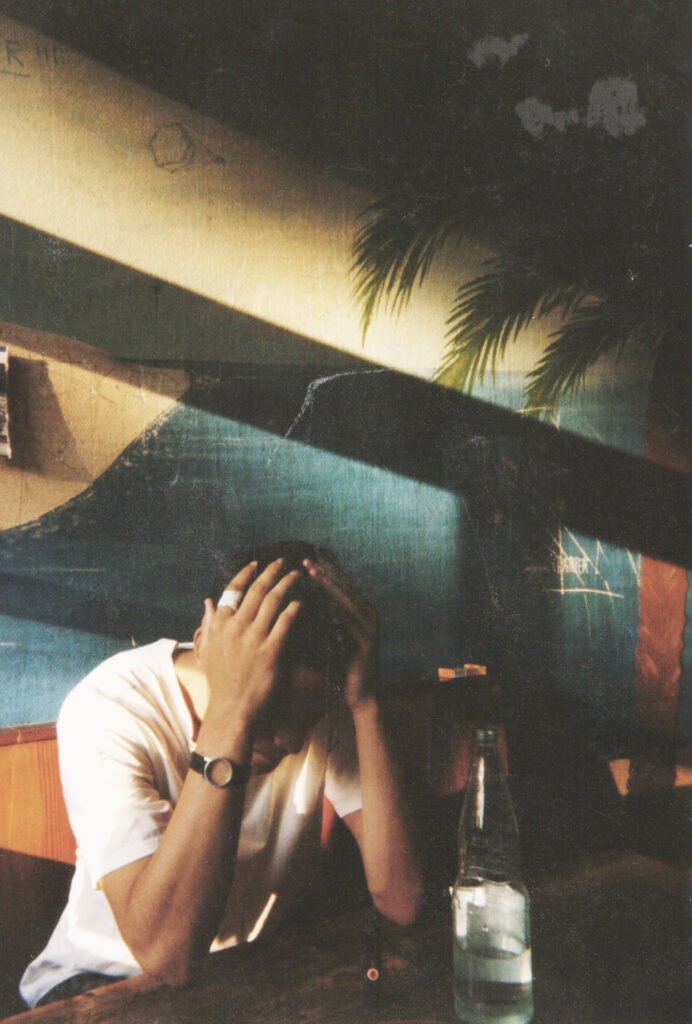
1995
I’m avoiding diving into the topic of psychiatric hospitals right now. Simply because the last time was a complete disaster. I don’t want to start processing it—if someone decides to lend me a hand, or if the social welfare state steps in, I’ll leave that to the members of the legal profession. But it’s important that a dialogue, a trialogue, emerges: patients—industry—ministries. And I’ll probably use this Saturday evening, here and now, to fuel this chapter with dynamite.
There’s no lobby for the mentally struggling, yet there are advocates in the form of social associations and institutions, like health insurance companies, and above all, the Medical Service. But it’s a complicated matter, and it’s extremely difficult—not just now, while writing, but when approaching and demanding justice. Where do you draw the line between treatment and arbitrariness? It’s not like a leg is missing, and every seeing person can tell something’s wrong. Arbitrariness as an approach in a treatment situation is, of course, my interpretation, my feeling, my assumption. What’s documented are records of accompanying staff with inadequate training, questionable personalities, sick, addicted people doing their best to earn a living—or worse, just wanting to help? Not to mention intelligence and comprehension, which would sometimes be unfair to judge, as it would expose desperation and helplessness. Yes, mine. Ours. But that’s just how it is. One against all. That’s how it feels. And then there are these memories, statements, and actions heard and observed by third parties, evaluated, interpreted, processed, and distortedly conveyed, subjugated to one’s own… well, what? Ego? To then rule, to control, to retaliate, or even to judge and punish. Is this still comprehensible to you? Are you thinking I’m going too far? Does this sound, as mentioned earlier, far-fetched?
Well, welcome to the psychosocial world of the healthcare industry. I write this without cynicism, but perhaps with a bitter aftertaste. Of course, this is my perspective on experiences I’ve perceived. But the bottom line is that all of this must exist, and yet it can’t go on like this. We can’t allow people to be locked away for days, weeks, months, mostly left to their own devices. Then, when resistance stirs and frustration breaks out, fed by despair, they’re told to suppress these feelings. And when that fails, they’re sedated with medication, where mass-produced overdoses don’t work. No programme, no emotional attention.
I still remember that facial expression when, for the x-th time, I asked to be allowed to make a phone call—this was on the third ward within two weeks in Mainkofen, Lower Bavaria—and I was asked what kind of number it was. “The telephone counselling service,” I said laconically. “Poor women, having to look at screens,” I thought another time about the nursing staff’s behaviour. One can only hope that total, AI-controlled video surveillance in psychiatric hospitals will soon be introduced so that the nursing staff can turn their attention back to the people.
Now, alone against all? Hmm. Well, I’m not entirely alone—I have 400 pages of medical records covering a period of fourteen days; well, some pages are only sparsely filled. I really hesitate to look into them alone. You might be wondering why? Hmm, then take a look at the deformed metal bin in my small kitchen. What does that mean? Well, feelings that just want to get out. And sometimes only brute force helps. Though only against bins. That’s what they’re there for—that’s why they’re called that. Okay, there’s a more charming term: Mistkübel—that’s what they call those things in my father’s homeland.
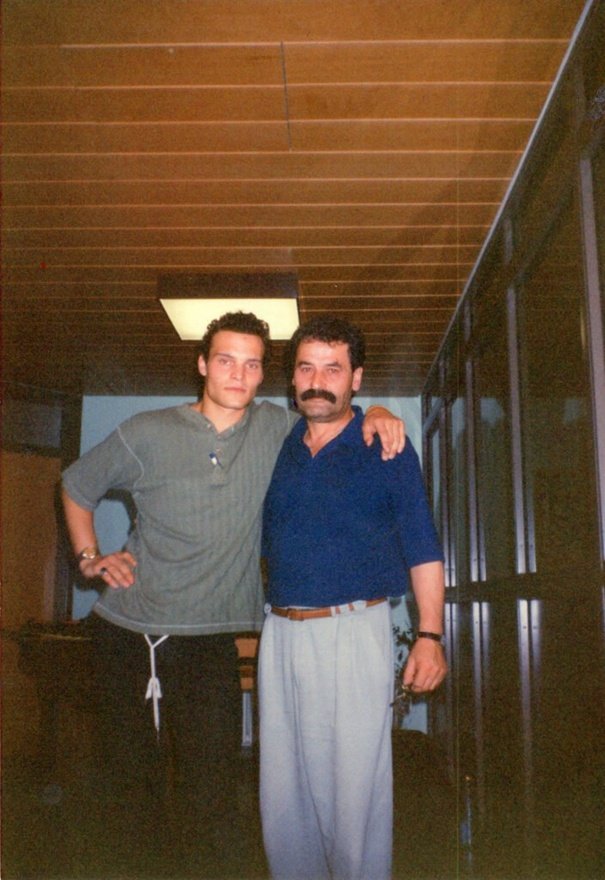
Harald and me, mid-1990s in Württemberg
Strange Women (II)
After the first time having sex on Reichenau Island and the affair with S. S. in Constance, there was a long period of calm where relationships with women were concerned. A cousin, K. M., a classmate, occasionally visited from northern Germany to Haigerloch, and that was a romance with depth. No half-measures. She even came to my place once, and I found myself in sexual distress. We made out on my mattress, and the only time I got an erection was when we moved the making out to the balcony outside my room. A disaster. It didn’t last long, and one night—it was a New Year’s Eve party in Hechingen—she was visiting again, but another abyss opened up, and I fell into it, trying to drown my sorrow in alcohol, and behaved more and more like an axe in the forest. Meaning, I nearly ruined the party—at least I provided the emotional soundtrack. And property damage. It was to mark the beginning of the end of my time with the Hechingen clique. And I never saw K. M. again. Later, there was contact on Facebook, but that was it.
Then came another long pause, followed by the kiss of my life, L. K., from and in Gammertingen. G. took this relationship as an opportunity to interfere once again and show me up. This looked like him having a private conversation with L. K., then presumably concluding that the relationship was doomed, but then letting me know that he thought this young woman was the right choice for me. Needle pricks.
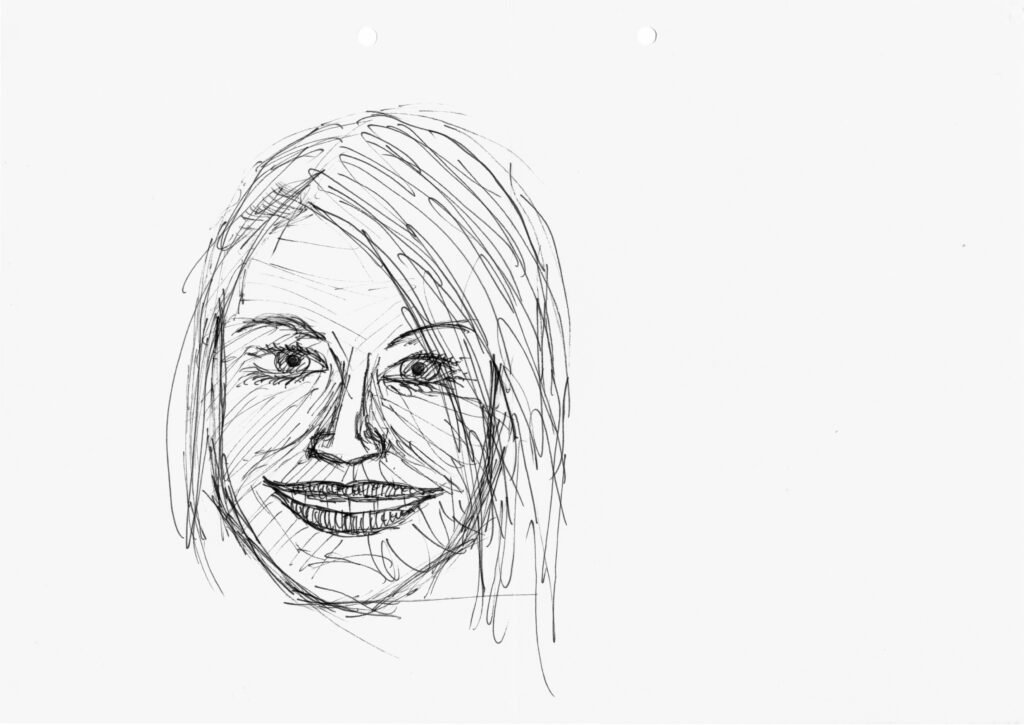
L. tried hard to keep me. She educated me a bit—at least she told me to shower after I’d been dancing for hours at the Tropicana and then wanted to fool around with her. But it was the minefield of excessive closeness that, after mostly three or four weeks in a relationship with women, made me retreat to a final distance. No one understood this. No one? Well, I’m not entirely sure about that now, but at least none of the directly involved parties seemed to understand.
The woman of my young life—even if it was the “least lived” love for me—was D. A. We met in 1996 at Delta Tau Chi—The Animal House in Donaueschingen. I don’t remember exactly how. All I know and can relive is the interpersonal warmth. We could talk for hours, driving through the countryside in a car to the sounds of Depeche Mode. No buts, but then…
When the chaos cleared, the memory remained, continually nourished by longing—for the feeling of intimate security and the feeling of being understood. But it was also the first and last time—at least it felt that way—that I had to lose a woman to realise I loved her. In love—a sign of this immense effort, constantly over decades, to suppress my feelings—I only felt last year, when the knot finally loosened, and I could finally say goodbye. My goodness. If it hadn’t come to that, it would have driven me insane.
That was it for love for a long time. What followed were affairs, one-night stands, anxiety alliances, little love affairs—just to keep that word alive. I didn’t experience that deep connection like with D. again until autumn 2024. I couldn’t exactly love freely then either—somehow the circumstances were highly complicated and very problematic (there was talk of possible stonings in the homeland, for example), and I was still emotionally hitched to G.’s wagon, but with one foot, I stood in emotional freedom. It’s comparable to a surge of water inevitably in free fall over a waterfall. The impact was bound to follow after this profound intermezzo with M. H.
It was comparable to meeting K. H. in the winter of 2003 during my first days in my chosen home of Munich. From the taxi taking me to the small Menterschwaige clinic, I caught a glimpse of a woman wrapped in a dark woollen coat, and I connected instantly. The doctors at this clinic, specialising in dynamic psychiatry, call it an anxiety alliance. Yes, I agree—anxiety alliance was accurate, but one that could transform. It continued even after we both left the inpatient stay there. Still, it never went beyond a purposeful partnership, even if we were both head-over-heels in love. We had one big thing in common: we both grew up in Stuttgart from the late 1970s onwards—that simplified communication. And based on today’s knowledge, it went even further: we both apparently had a narcissistic, control-obsessed man alias father figure in our lives. That paved the way for deeper understanding.
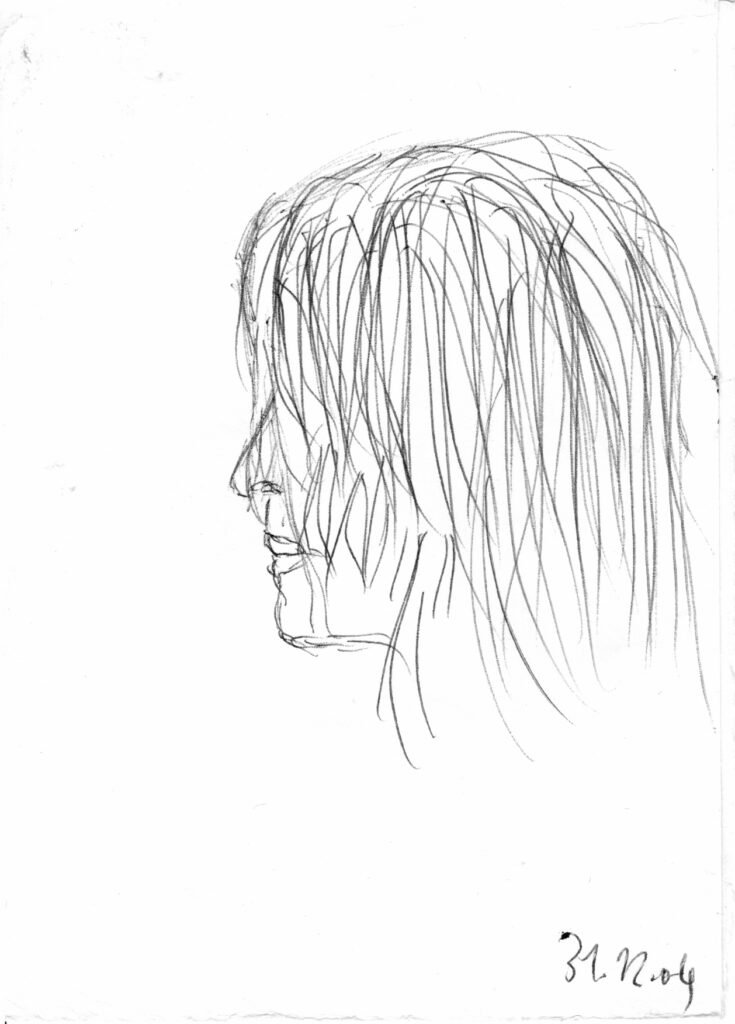
K. H., 2004.
The intimate relationship with K. H. would become the longest official one in my life so far. In second place is M. L., whom I dated during my Augsburg days, and who carried a very intriguing theme: she was a single mother to M. M. was two years old at the time and would occupy my thoughts for a long time. It’s difficult to describe this relationship—many family traumas intertwine, which refused to resolve because all parties involved seemingly tolerated and ignored all misconduct within the clan, which naturally seeped into our story. But during this time, the band holding the crimes—yes, how can…—under the rug burst in one or two places. I hope you’re doing well; both of you. It was really difficult to process this relationship. I don’t mean the one with the young mother M. and her family—no, I created space between us, and it did go beyond a purposeful alliance. I meant the relationship with the child. This resolution took several years and led me to avoid entering into intimate relationships with mothers ever again. It grated emotionally for a long time. And the catastrophic separation carried out by the family in the background, along with the pretence of false facts, did its part. That’s all I’ll say about that.
Here’s the continuation in the same raw, unfiltered British English style, preserving the emotional intensity, fragmented structure, and grammatical quirks of the original:
Strange Men
I must have giggled for a good half hour after I, pretty annoyed, made it clear to the two policewomen that their investigation into this matter was based on a misunderstanding. “I don’t want to hear anything more about it,” I said, almost angrily, at such a stroke of bad luck, and walked away. Forty years of friendship ended. Or maybe not? It’s curious. Ah, B… Let’s see how things go with us. B. L. is a soul of a person, and a busy one. We’ve been through a lot, and sometimes apologies were exchanged, mutually. But can this heal? I’m not hurt, and that’s already worth a lot—it’s just a tangled situation. But I don’t want to untangle it here. I’m more than his friend; over time, I’ve become a friend of the family, even if I don’t know every member well. Some of you might relate. The age difference was already strikingly large—seven years—and we stand on different shores, though that doesn’t mean these shores haven’t had a connection at some point. It’s been interesting. And of course, extraordinary. And many experiences were, of course, only possible because of his financial freedom. That somehow stood in stark contrast to the otherwise tranquil and very quiet village life. The friendship remains exciting, that much is certain.
That it can be different, I learned before this encounter. Fortunately, it was at a time when I wasn’t yet storing everything I experienced—possibly corresponding to the nature of the experience. Experts like to call this “dissociation.” For me, that’s a bit too abstract; I can’t do much with that metaphor, which might also be due to the nature of the event. I don’t remember exactly what I experienced. But there were two psychological, or mental, breakthroughs: once as a shadowy, vague memory in the form of an emotional process, twenty-five years later… and of course, self-realisation, in which I recognised actions I performed on myself in private, which led to the suspicion that I was compulsively repeating something to process early childhood experiences. So the approximate realisation and self-experience remain, but the final proof remains missing. However, if I were to name the remaining doubt, it would be close to zero in the per mille range.
The day-care family I had to visit, where this unspeakable sexual abuse most likely took place, was in Stuttgart-Birkach. Apparently, this woman L. still lives there; her son, C., apparently works for a bank. That much could be determined last year when I took a virtual trip to that corner of the country, that city. It was nerve-wracking. And I haven’t completely shed these survival-necessary reactions to this chain of events, though the efforts of recent years and these compulsive repetitions have been worth it. It’s like shedding skin: it takes a certain amount of time, it’s a struggle, you have no help—at most, tools—and it’s unavoidable if you want to develop further.
Perhaps it’s true, if there’s any merit to this concept of reincarnation and the theory that you’re burdened with old debts from past lives in the current one. A possible explanation for why, after the torture in that quarter of the Swabian capital, the game wasn’t over—only the opponents were replaced, and thus areas were covered that could only be reached with precision and, however, far more calculated villainy. “Psychological bodily harm,” that’s the technical term. But it’s a similar game, as already mentioned, also recognisable by the fact that compulsive behavioural patterns were again carried out to cope with the stress, though the final proof is emotionally anchored, to be found in my inner life. Exclusively. Almost. I nearly ended up completely empty-handed. However, last year, I managed to secure evidence. That’s a huge relief, and despite all contradictions, it contributes to the healing process. That’s the advantage of long, toxic relationships—(supposed) trust flows in both directions.
G. was a challenge, that much is certain. And now, in my mind’s eye, I see nearly dead, or at least evil, black eyes sparkling, but then I also remember: it’s a psychiatrically diagnosable mental disorder that made him who he was throughout his life.
As for the rest of the family, the cards naturally have to be reshuffled. However, the cards remain the same, even if the game is different. I can only urge myself to refrain from excessive harshness, because these people—my four half-siblings—have been manipulated their entire lives, raised “against me,” and the two younger ones were brought up with almost no conscious influence from our mother. Nevertheless, personal responsibility remains. You can’t give that away—you must realise that. And even if you won’t be able to perceive it, that was already a conciliatory gesture on my part.
Enough of that.
Part 3
Beyond Good and Evil
It’s a huge advantage to write an autobiography from one’s own life. Not compared to nothing—since the internet age, there’s probably almost no one left about whom no record exists. No, I mean compared to a biography written by a third party. Here, as you’ve just noticed, the inner process is always active, so to speak, simmering, and a direct—albeit currently one-sided—dialogue takes place. That’s already a help in moving forward, even if the intention and goal is “letting go.”
Letting go, yes, that’s really good. Over several decades, quite a lot accumulates—not just objects. A hundred or a hundred and twenty years ago, people around here owned about a hundred things. Now it’s a thousand or more on average. Allegedly. Of course, it’s a big help to sort things out after such a long time—objects, relationships, unprocessed memories. Hence the reduction of my circle of friends through increasing reflection and personal development. We don’t want more—things, conflicts, excitements. Understandable and relatable. We live our lives; it’s a joy to see so many children growing up healthy, even if technology is taking over. Please don’t misunderstand me—technology is useful as a tool, but it’s now probably being used as an addictive substance and substitute, which is concerning. Therefore, paths like the one the Australian government took at the beginning of 2026—banning social media for children and adolescents—are worth supporting, in my opinion. Now, that’s not the only turning point in our society. Globalisation. Lack of movement. Widespread obesity. Alcohol consumption. Smoking. Drugs. Border conflicts. But it will be resolved—I’m convinced of that.
Once, while moderately schizoaffective, I marched through Augsburg and met the wife of a local politician in a pub. She told me her husband discussed security issues, to which I replied that it only makes sense if you can protect yourself. So, how about you? Can you protect yourself? Can you recognise and avert impending dangers, manage incoming conflicts—not just with brute muscle power, but especially with technique and cunning? Yes? Very good. I suspect, however, that most people here would have to think longer about it and might want to put the book down first. Thank you for continuing to read.
It’s quite simple: the benefits of globalisation aren’t just materially tangible but, above all, culturally tangible through the mixing of cultures. My mother had a book about Jiu Jitsu on her shelf back when we lived together in Stuttgart, which occupied me greatly. I sat there for hours, studying the stances, which naturally weren’t much use to me at the time but paved the way for me to become active in that field later and today. What does that look like in practice? At the bus stop, a man is hitting on a woman. With some practiced communication skills—which I assume women have and think I’ve learned from them—I unconsciously move into the vicinity of the situation. It continues; I engage the young man in conversation after the girl finally manages to put some distance between them. Where he’s from—I don’t know his language. Where his girlfriend is, and so on… and then I let it go. But it continues on the bus: the man won’t leave the noticeably younger girl alone. I keep observing, listening, staying nearby in the sparsely occupied bus. Earlier, I’d managed to glance at his smartphone screen, which he held up to the girl—who might be from his cultural background but seems to speak a different language—so she could read the translation via the app. “Why are you so sad?” it said. He approaches her again; I’ve seen enough and say to him, “She’s too young for you.” Not because I think so, but because she looks about fourteen or fifteen, and he’s definitely about ten years older. He agrees, nodding, sees the futility, and backs off.
It’s not about telling someone what to do, you know what I mean? It’s about being correct, truly following your subconscious and inner voice, and caring for people. Where would my behaviour have led if I’d forced myself between them at the start, perhaps feeling like a law enforcer? Or something similar. I just showed presence, observed, and accompanied. And when the suspicion hardened that neither he would let up nor she could defend herself, I intervened gently and appealed to his correctness through correct behaviour. That’s why it’s important to proceed carefully to understand how both tick. Is this a plan to drag me into a conflict or an ambush? Is he on drugs or drunk? Can she defend herself? All that must be considered—felt—if you don’t want to steer towards disaster. You can learn this. And practice it. One way to approach it is through Asian movement arts and medicine, then self-responsible action and reflection, to increasingly dwell in the moment and not be constantly plagued by longings. In the longer situation I just described, it wouldn’t help if I undermined his attempts to get closer to the girl just to score points myself and get closer to her. Anyone in their right mind should understand that. And if addictions—even psychological ones—are involved, it quickly becomes dangerous. Then the techniques of Asian movement arts are needed; yoga might not be enough. It’s a help when it comes to appearing confident and deterring just by not backing down, but if it comes to the worst, technique is required, not necessarily just muscle power. And that’s why we should all—especially women—learn and study Far Eastern techniques (more and more). Even if it seems strange at first, and no deeper meaning is immediately apparent. Though I find the latter hard to imagine, especially when I think of the song by Céline and Paula Hartmann, which addresses a problem that’s existed for thousands of years—“3 Sekunden” is the one I mean.
Now, I’ve addressed women and those who want to become them (or would). What about us men? Apparently, the damage caused by self-overestimation runs into the billions. And when it comes to pure physical effort, we usually look pretty good in the mirror. But we occasionally make a mistake—we don’t know ourselves well enough. For example, in stressful situations. According to reports, we then stare at our opponents, which some already call “eye-fucking,” and they feel attacked as a result. Now, if such a conflict goes into the next round, we—depending on which cultural background the man comes from—face a great unknown. And it looks like this: some Iranians, for example, learn karate in school; some Russians call their friends; some Arabs completely lose it and can’t control themselves at all. Then good advice is expensive, and quick thinking is priceless. What good is a virtual chat partner or an affair in the neighbouring city if you’re alone on the road? Have you ever wondered who’s coming towards you in the dark and whether they know the person who just turned into this street behind you? Admittedly, this is getting paranoid. Well, the Risperidone is still working; for me, the world is in order. That was just a sensory impression from a paranoid schizoaffective phase, in a situation at 11 p.m. on a side street in Munich. But how are you doing right now? How do you feel at the moment, and what are you thinking?
Everything’s fine—it’s just a book. But if it becomes a film, maybe your friend or girlfriend in the cinema is reaching for your hand right now. Who knows?
Here is the continuation of your translation in the same raw, unfiltered British English style, preserving the emotional intensity, fragmented structure, and grammatical quirks of the original:
Seeking an Anchor
Ah, the populists—they’re carrying on now. They know no mercy. Thanks, Mum, for raising and guiding me the way you did. I felt your mistakes, I acknowledged your blanket apology, but of course, I couldn’t give you feedback on it. God’s will? The Devil’s will? Fate? The ancestors? We’ve been here before, further up the text. I’m widening the circle now. It’s the ultimate mystery, but we do what we want. And I want to head to Sicily. Not a one-way train ticket, like in my dream, to travel with my potential wife to Japan and spend my twilight years there… no, maybe that’s too much, too far, too complicated. From Munich in twenty-four hours, first on the night train to Rome, then a transfer by changing stations, maybe even spending a night in Italy’s capital… and then on to Sicily. I won’t reveal exactly where. Please forgive me, but here’s a tip: the documentary series “The World of Spices” as inspiration. And then a bit of anchoring, a bit of enjoying, a bit of working—just living, dolce of course. Italians are probably laughing now. 😀
So, I really wish for such an alternative anchor place in my life. Having spent the beginning of my childhood in a big city and the following years in the countryside—not exactly cut off from life—I appreciate both. Even the six or seven weeks I recently spent in Pemmering, in an Airbnb room, were a pleasant change and showed me that I need that occasionally, even without a specific trigger like back then. Forest and meadows, or the sea and a volcano.
Of course, this requires money. Money isn’t that important to me, though I do like earning it and spending it. Within certain limits, savings are naturally relaxing. This has gotten a bit off-balance, though “a bit” is an understatement. This emotional and, to this day, ongoing financial dependence on G. and the public purse contributed to this, and I submitted to my fate. For a few years now, I’ve been making creative efforts to shift and distribute this dependence. You’re only truly independent if you’ve built up really high savings—or inherited them, own property, and have such things in the background for a certain sense of security. This state of perpetual cash flow shouldn’t dry up, at least that’s how I plan it for myself, which also means I’ll work until I die (which, in my case, means living). But the question is, how much possession is good for you? Maybe it’s also a matter of attitude. What can you really own besides your life and humour? Well, you might know what I mean—it’s about bringing peace into life, though the question is whether control—and I’ll just call it this—ownership of material goods brings peace, or whether it’s just about building and protecting walls. Just recently in Pemmering, the largest property on the street was secured by two aggressive dogs. That, of course, wouldn’t work for me at all. Let them do it, but I’d rather live modestly and discreetly, you know what I mean?
Alright.
Strange (Ex-)Couples
U. W. was one of the few women who took the initiative, even if it was a bit clumsy. She intercepted me at the Tropicana in Albstadt-Ebingen, late at night on my way to the toilet. She—so much I know today—was looking for a rebound affair, and we fucked for a while, much to the dismay of her ex, H. H., once even in their bed (they were still living together). But it’s true that we’re in touch again today—somehow, for reasons still unknown to me, I re-established contact. In the age of social media, that’s nothing unusual, but the dialogue presents me with puzzles.
With her ex—I mentioned him earlier—I became friends. He’s also an unusual guy, and I still like him, even if the active part of our friendship came to an abrupt end one day due to my youthful harshness back then. But I found—and still find—behaviours like visiting me at work to see how I was doing during a depressive phase wonderful.
Another couple where I probably caused separation intentions with my penis followed shortly after, also in Balingen. I don’t remember their names—I arranged a mobile phone contract for them through my then promotion and consulting business—but it ultimately led to them lying naked on my bed and then letting things take their course.
A third time I interfered with a couple, it was my conscious decision. I couldn’t stand by and watch: a young couple with a child, he apparently often stoned, constantly ruining their very lively child’s play and exploration in the flat. Plus my intuition. And then, of course, my libido, which, though skewed by the sex addiction that had clung to me for over ten years, wasn’t yet clear to me. In everyday life, I used my body on various levels, meaning this was the time when I compulsively repeated sexually oriented matters in Augsburg, as I had repeated them as a child—as I described earlier. I ploughed through my daily life like a driven man, but I took her—the young German-Turkish woman—into my world for a few hours. She accepted, and it was enough to turn her life upside down and—at least in my opinion—put some things back in order, or at least reset them. His subsequent behaviour—even if it occasionally complicated my daily life—undeniably proved me right. Sometimes distance is needed. Also—or sometimes especially—between father and son.
Beyond Good and Evil (II)
I now look back on such things and behaviours—like when I interfered with or inserted myself into strange couples—as instrumentalised by the will of a higher power. Of course, I’m aware that this can be seen as abdicating self-responsible action, but that’s far from my intention. I submit to the contexts of the world, even if that occasionally means (or meant) aligning things and matters with my own standards. I know, I know, you could say I’m judge, jury, and executioner in one, but I see it from the perspective of social courage and thus value it as self-responsible action.
Today, things play out a bit differently. This Sturm und Drang phase has largely been shed and endured. These days, I practice non-interference, also because I understand the nature of women—and men—better, and can better categorise longings and emotional needs. But if I see the appalling conditions in which children are sometimes “kept,” the fun’s over. That much is certain.
Higher power, yes, by that I also mean our sex drive. Yes, it’s inherent to us, rooted in us, but in a broader sense, it’s a higher power beyond our influence. We submit, even if many give the impression they’re acting. Such unspeakable violations as rape are simply psychological disabilities and usually psychiatrically diagnosable—without excusing the behaviour. This is an absolute no-go, that’s clear. This sex addiction also sometimes takes forms like what allegedly happened in my circle of friends, where an adult man became aroused by a child and used and abused it. How do you deal with that? I have to admit, I’m stumped there too, and that’s when it’s our task to keep an eye on neighbours and friends, and occasionally put our finger on the wound, drawing attention to grievances. In that regard, concerning R., I also feel like I’ve failed.
Yes, higher power and misdirected needs, even addiction. It’s complex, that much is clear. And if you’re left alone with it, it’s all the more complicated because you usually can’t see beyond your own nose in the heat of the moment. And then it happens, all boundaries are crossed, social life is messed up, and the child’s life is overburdened far too early. But who’s to blame? I ask this question seriously. Who is at fault?
This is what it looks like when you unconsciously devote yourself to life, without intending this as a reproach. V. D., on the other hand, completely refuses to engage. That’s another way to approach life. This unspeakable fear of depth and confronting an inner conflict—probably externally induced. Both cases are tragic, in my opinion, because, even if this now sounds judgmental, both lives are in shambles. Of course, it’s only too late when the screws are tightened on the coffin at the funeral home, so I keep trying. But it’s also annoying. But who’s to blame? I repeat this question because we all tend to say, “each person is responsible for themselves.” And isn’t that the question?
I live my life largely alone, but in this context, I often wrote “we.” And this “we” includes everyone. Each and every one.
Enough of that.
Part 4
School
“This one’s for you, this one’s for you,” she said, approaching me from behind on the open street in Owingen, and held out a dark green snake cucumber. I was surprised. “Oh, did I lose this?” I said, puzzled, and, funnily enough, assumed that this cucumber had fallen out of my backpack. This marked the beginning of a wonderful acquaintance. Weeks later, back home in Bavaria, I went through my efforts to continue building my life and leafed through a folder G. had sent me. That’s the downside: he’d kept it for forty years. Drawings I’d made in primary school. Among them was a sheet on which my mother had apparently noted the names of the pupils in the second grade in Groul. And there it was: P. V. Strange. I remember that school time, as the other students probably do too: fragmentarily. Conflicts in the classroom, conflicts in the schoolyard, and the federal youth games. Later memories open up insights into the lessons, the realisation that I was apparently a late bloomer when it came to manual work like crocheting. Also stored is the interpretation of a glance from our class teacher at my shoes. Yes, I believed he was looking at my dark blue suede shoes, which I was wearing for the first time that day and which my mother had chosen without me. I never wore them again.
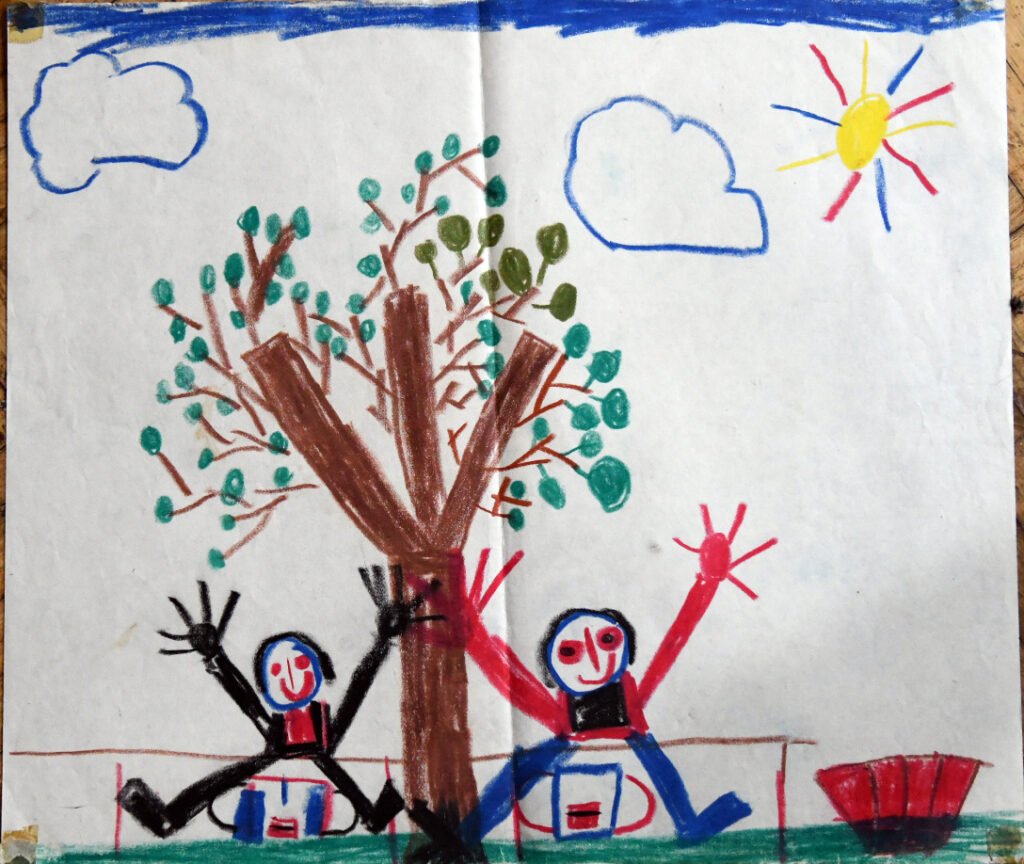
Circa 1981.
Accompanying me through this school time were my strange hands. They were covered in warts until my step-uncle U. G. once said to suffocate the oldest wart with super glue. It worked. Thanks a lot. Also, I constantly had cracked fingertips, which was also pretty unpleasant because it was painful. Adoptive great-aunt J. S. said, “Pee on them.” Which I found very interesting—not just the statement, but the action itself.
Later, I went to the Progymnasium (a type of secondary school) in Haigerloch, which at the time was a special form of Gymnasium offering education only up to the tenth grade, meaning you had to transfer again. I didn’t. I wrote the central exams in the tenth grade a year later than originally planned and left without taking the final exam. That was suggested to me. No one understood how I ticked, including myself. I had an inkling due to my behaviour in maths class but couldn’t apply this behaviour to my life. I didn’t pay attention when Mrs. B. B. explained something new to us; I did something else instead. Later, at home, I found my own way to the solution, with an occasional glance at the book, of course. I liked it that way. Only a few years ago did I understand that I’m what you call an autodidact. Hmm.
So, yes. The time in Haigerloch was eventful. My worst grades were in French, even though I loved the language, but I couldn’t get along with the teacher, Mr. K.—I simply ignored him. My kryptonite, so to speak: if I couldn’t connect with the teacher, I didn’t learn. It was similar in chemistry. There, although I liked the teacher, Mr. A., even if he occasionally retreated to the back room to drink alcohol, the subject itself didn’t interest me. Maths saved me, as did sports and English with Mr. M., who also accompanied us to the school camp. He was my favourite teacher. He was tough but fair. To this day, I quote him with his attitude, reflected in the statement: “Once is never, twice is once too much.” Usually, this was about undone homework. Looking back, there was really only one teacher who turned out to be an enemy, less because of his apparently paedophilic nature than because of the punishment he imposed on my half-brother A., the older of the two, for not doing his homework for Mr. L. at the beginning of fifth grade. “So it doesn’t turn out like Thomas,” was Mr. L.’s reasoning, which drove me to white-hot rage when I found out. Well.
After the Progymnasium came vocational school, one year full-time, and as a accompanying measure, some work at the training company. Originally, I wanted to learn photography but—possibly due to poor applications and a lot of ignorance in the field—couldn’t find an apprenticeship, so I decided to become a draftsman. That was a good decision. Drawing: yes, technology: no, to put it bluntly. It took several attempts, and I really got around during that time—Balingen, Hechingen, Rottenburg, Jungingen or nearby, Schömberg, Reutlingen, and the highlight: Biberach an der Riss. A mad time. In the truest sense of the word, as I’ve already described in detail, and a very eventful phase of my life. Wonderful. During this time, I also grew a lot—internally, of course. The profession was a purely social necessity and was to play a subordinate role in my life. The training and practice—the pure drawing and mastering fine motor skills through learning standard script—were priceless to me.
But my social life also restarted, especially because of the wide circles I moved in across the country, primarily the vocational school in Biberach, about 80 kilometres away, which was held in blocks—meaning most students lived in the dormitory on the school grounds during these phases. W-O-N-D-E-R-F-U-L.
But of course, there are also tragic incidents, as everyone knows, and sometimes the worst really happens: my colleague, whom I attended full-time vocational school with in Balingen and knew from before, Cem Günyar, simply dropped dead in the bathroom one morning. He left behind a wife, a sister, and, I believe, two daughters. This at least broke my heart.
Work
I’ve enjoyed working from a very early age. Though I didn’t particularly like every task—this closes a circle—it depended on who I worked with and how much it challenged me. My first job was as a newspaper delivery boy, then one of the best in the carpet department of a furniture store in Owingen, followed by work in a landscaping and gardening business, then back to the furniture store as a furniture delivery and assembly service worker. When I was older, I worked for a longer period in the same company in the lamp department and as a salesman for garden furniture, which was quite demanding and I learned a lot, especially about my stubbornness in professional terms and also a lot about dealing with people. The German Red Cross was another stop, and then I also got more involved in the hospitality industry. Things got serious in the mobile phone industry as a consultant, promoter, and merchandiser, and for the technical hotline of a pay-TV channel. During this time, I gradually moved to Augsburg in Bavaria, which I actually took my time with. The last job I held—but didn’t get past the probation period—was a hybrid job in appointment scheduling and at the bar of a physiotherapy centre. That was it for fixed or at least part-time jobs. What followed were only internships and voluntary work, and again self-employed or commercial activities, though I had to take over a year to develop and fundamentally orient myself. The crux was simply that, due to this narcissistic grit in the gears, I had developed and reacted in such a way that I moved between levels for the public—personally and professionally—to avoid being tangible, which almost resulted in a final vicious circle if it hadn’t been for decades of conversations with psychologists, psychiatrists, and educators. I’ve already expressed my thanks to them in person, but I won’t tire of doing so again here: thank you very much, many heartfelt thanks to Claudia Käfer, Jasmina Metz, Astrid Thome, Mr. Schmid, Wolfgang Wolfrum, Thomas Truxa, and many others in the many clinics whose names I can no longer store for practical reasons. Thank you very much.
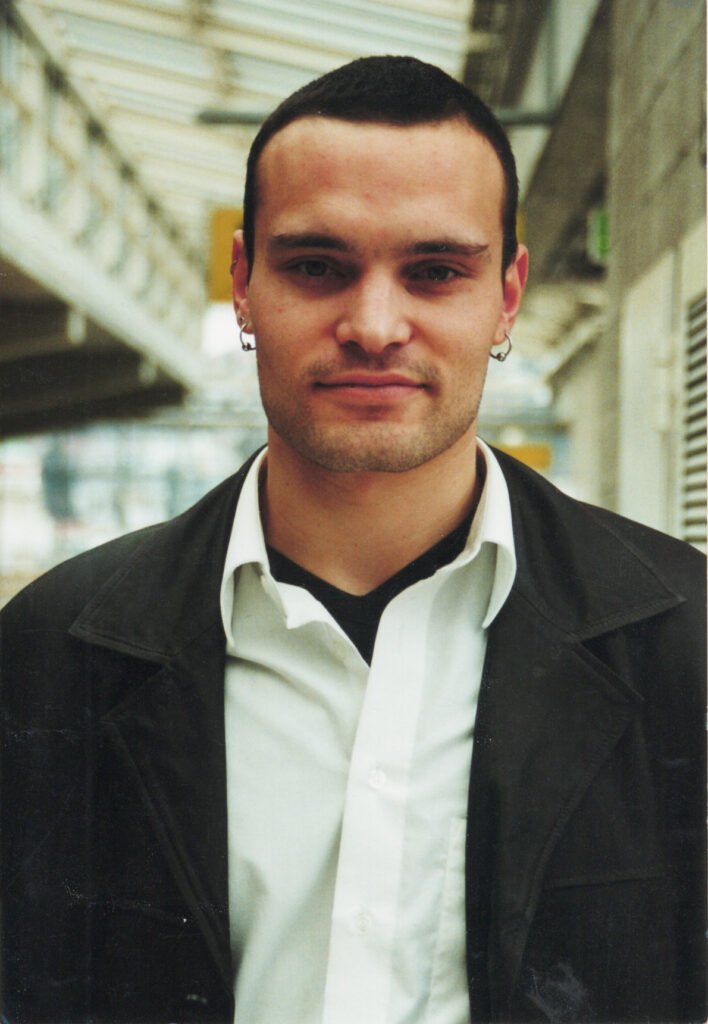
Now, that’s it. The chapter is closed; now it’s about capitalising on the whole story. As Aristotle allegedly said, which I read on a calendar note in the community centre here in the neighbourhood an hour ago: “When talent and the world’s needs come together, we call it vocation.” As I already clarified in my introductory text on the back of this book, I orient myself more towards Far Eastern philosophy. In fact, I’m even convinced that some of my ancestors came from there, partly over land, partly over sea. But often, the ancient Greeks and Persians also hit the nail on the head.
I’d be happy if your path and mine cross again, whether through another book, maybe a film about this or that, a written dialogue, comments on social media—there are so many possibilities. Let’s use them occasionally and mend the rift between your world and mine, if it truly exists, still or again. In summary, I hope we’re in the same bubble. I hope you found the journey to this point exciting too. Everything that follows is an encore and a gift:
Please visit the website: thomasschmoll.ruchami.com. The gift is stored there and ready for pickup.
Acknowledgements:
Please, to those of you who have been and are honest with me: many heartfelt thanks. I’m also very grateful to those who weren’t honest with me, because they truly challenged me. So, merci to you.
The greatest gratitude, however, goes to my ancestors, first and foremost my mother and her mother. I love you.
For the Liener family from Owingen.
https://link.deezer.com/s/32kgpWx55rOd88I8be5vU
01.02.2026
Thomas Schmoll, Munich
(translated from German by Mistral AI – Le Chat)